
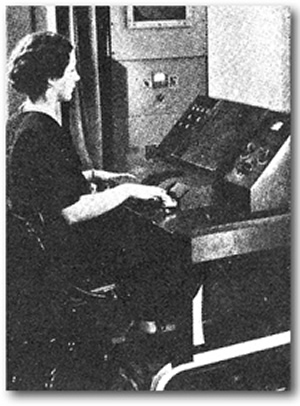
AT & T Page 1 
The photo shows the operator's console for AT&T's Voice Operation Demonstrator (Voder), featured at both the 1939 New AT & T VodermachineYork World's Fair and the Golden Gate Exposition. The console's keys were used to produce the different components of a human voice and the foot pedals controlled inflection.
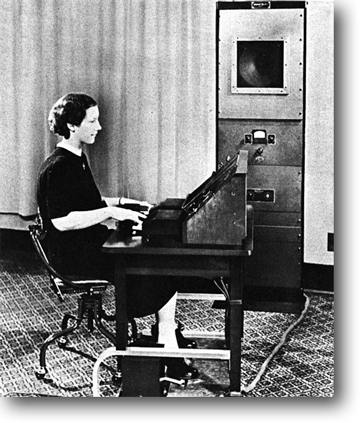
Apparently, it took considerable skill to make the Voder produce intelligible speech. By the Fair's second season, however, some operators had even learned how to make the Voder sing as well as talk. (On the Fair's last day, it sang Auld Lang Syne.) This photo appeared in the September 1939 issue of ETUDE MAGAZINE.
(as of 12/6/10 page no longer available)
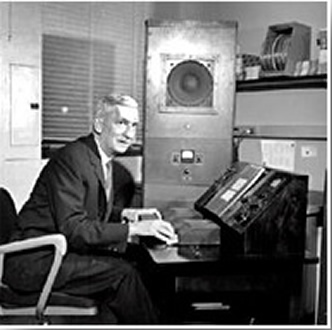
In effect, Dudley had figured out how to synthesize sounds. And, thus, he quickly ascertained the vocoder (or voice coder) had creative potential beyond the transmission of phone calls.
To publicize his breakthrough, he created an offshoot called the Voder for the 1939 World's Fair in New York. Using a trained operator who manually pressed keys to produce sounds, the Voder (or voice operation demonstrator) could transmit complete intelligible sentences and imitate the sound of various farm animals.
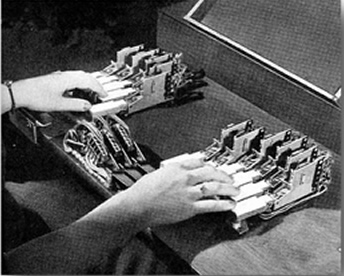
Photo from Tales of the Future Past
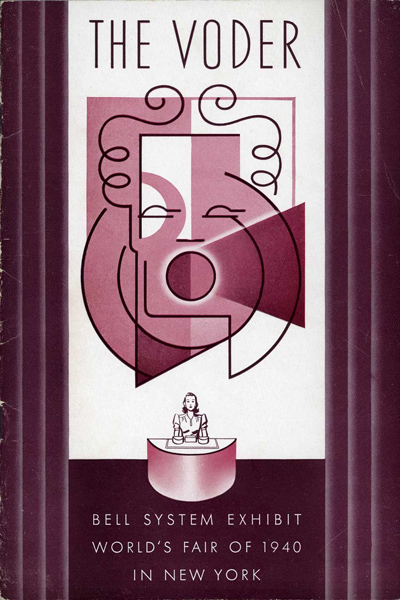
EphemraStudies.org
Why It's Interesting
This booklet describes Bell Telephone’s demonstration of a new technology, the Voder, that simulated human speech mechanically. Instead of using recorded snippets of actual speech, it employed the kinds of electrical circuits and apparatus found in everyday telephone equipment. Voder was short for “Voice Operation Demonstrator.” This was not intended as a commercial technology but was entirely for demonstration purposes. Operators learned to produce “about fifty different sounds used in the English language.” Switchboard operators trained for a year to give thee demonstrations. They produced “fairly intelligible speech” by playing on a keyboard like an organ’s. During the 1939 demonstrations at the New York World’s Fair Voder could only speak, but in 1940, some singing was introduced. Users nicknamed Voder “Pedro,” named for Brazilian Emperor Dom Pedro, who participated in Alexander Graham Bell’s demonstration of the telephone at the Centennial Exhibition in 1876.
Voder is hardly remembered today and might be completely forgotten had not a few avant-garde musicians began in the late ’40s to incorporate its technology and effects into their compositions.
Mal Ferrete Vazquez August 5, 2014
AT & T Page 1
- Return to:
- Communications