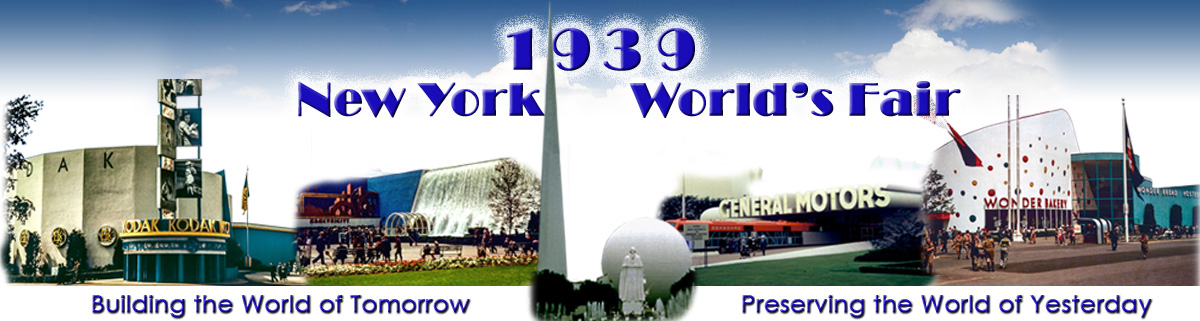

The Food FOCAL EXHIBIT was located in Food Building No. 3 (Food South) on Agricultural Row. Distinctive features of this rhomboidal structure were four tall golden shafts resembling stalks of wheat, and, on the facade facing Lincoln Square, was Witold Gordon's mural depicting food as a source of energy and health.
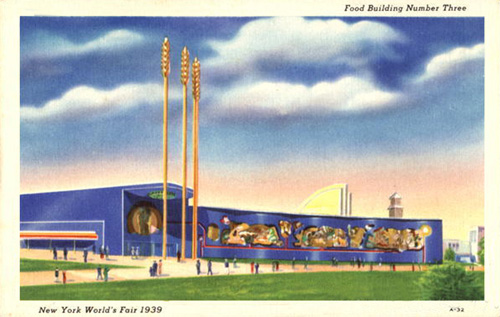 Witold Gordon's mural on the building's facade offered a 6000 square foot depiction of common foods.
 After the 1940s elimination of fair's zones Russel Wright's surreal focal exhibit was allowed to remain, but the building was turned over to one of its exhibitors, Coca Cola, and it bottling plant.
Click here to open / close the panel
Though it dealt with humble, common, place things like "bread and butter," the Food Show (Russel Wright, designer) was high and amazing entertainment. Comprehensive and dramatic, the Exhibit illustrated the progress made in the cultivation, preparation, processing, and distribution of food since 1789. The techniques of Coney Island, the atmosphere of Forty-second Street, comic cartoons, and "slapstick" were among the amusing devices employed to" stage the "Miracle of Modern Food" for millions of Fair visitors.
As you entered the Focal Exhibit Hall, huge gleaming monoliths seemingly floated in a red dusk and presented a strange and uncanny scene. Here was motion, the eerie movement of fantastic shapes. You saw a thick disc against a sprawling serpentine wall. A wide circular ring lied flat on the floor near a rippling, ribbon-like screen. An uneven six-sided prism crossed the path of a tall cylinder which in turn soars upward in violent contradictory manner to cut across the horizontal bulk of a huge egg-shaped form. A figure labeled •"Man" on the disc moved ever upward, its superimposed pattern constantly altering to represent the changes from Man's physical composition to their chemical equivalents. As Man fades, a cutout figure of chemical apparatus takes his place to represent the thirty-five elements, acids and vitamins which compose the human body. While the chemical apparatus is in full view, the word "Chemicals" appears after the word "Man," so that the caption now read "Man-Chemicals." Again the scene fades to a red that becomes steadily brighter, revealing a composition of food fantastically executed in materials, such as silk and feathers. The caption now reads "Man Chemicals-Food."
Clouds and sky writing moving horizon, tallied across a flat scene, showing the optimum diet. At the center of a window, in which a mirror reflects your image, an arc of food continually rotated and a sign beneath it read "Your Daily Diet." Similarly your "Yearly Need" was shown, and the "yearly need" for 130,000,000 Americans was illustrated by contrasting mounds of food with familiar landmarks on Manhattan Island.
Around the rotating cylinder, a series of illuminated figures represented the food producer of 1789. Here was Man loaded with numerous tools, behind him a mixed assortment of foods. A sign read "1789 Food Production." Other figures of men appear, each man with one tool used in food production, behind him a pile of food associated with the tool he is holding. The sign now reads "Modern Food Production." Thus the comparison between the food production methods of 1789 and our more highly specialized and effective methods of 1939 were set forth.
If you paused to think, you realized that the miracle of the "loaves and fishes" is no more incredible than the food miracles of today. Picture, for example, the amazement of great-great-grandma could she but return to earth to find our tables veritable magic carpets upon which may be set at any season (and all at one time, if we will), food from any part of the world. She would be astounded too, to learn that like witches' potions certain diets may affect our love life, our sex, may make us grow, can actually make us live longer.
At the end of the hall, the climax of the show was housed in a huge 60-foot egg-shaped form, or ovoid. As you stood eye-level at a window which stretches for the entire length of the ovoid, you'd gaze upon as hysterical a landscape as any surrealist ever conceived.
An avocado with five jewels glowing from its skin surmounted a scabrous mountain peak, a flight of lobsters wings its way into the mountains from the seas, a great trans-Atlantic aqueduct spills roses into a desert, while an eye blinks mysteriously from a cave and a clock inside a can races madly backwards. Suddenly the mystery is cleared by a voice, saying: "This is the kind of a world your great-great-grandmother would imagine we lived in if she were told of our countless achievements in food." A light flashes on each object as the voice interprets its symbolism. ... The avocado's five jewels: the five precious nutritional elements found in food-carbohydrates, proteins, fats, minerals and vitamins. The winging lobsters: modern transportation makes it possible to have fresh fish in landlocked mountains. The blinking eye: man's victory over night-blindness through Vitamin A foods. The clock running backwards: canning has perpetuated harvest times. The aqueduct: irrigation has flowered wastelands.
The startling anticlimax to the show was the exhibit "the challenge to the future," which was housed in a huge chamber under the ovoid itself. Here the walls and ceilings impressed you with their grave message of food questions yet unsolved. Springing from the shadows, newspaper headlines and photomontages graphically depicted a score of acute food problems darkening man's future. As the show ends, you turned away reflecting on another unfinished job for the "World of Tomorrow." Yet every unfinished task is a challenge, an opportunity for an additional achievement in man's progress.
Comprehensive and dramatic exhibitions of the progress that had been made in the cultivation, preparation, processing and preparation of food since 1789 was the focal point for this pavilion.
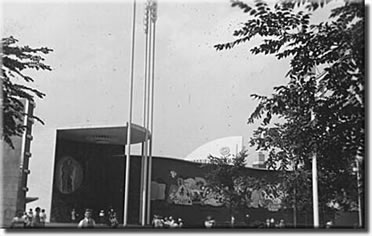
by Arie Van Dort
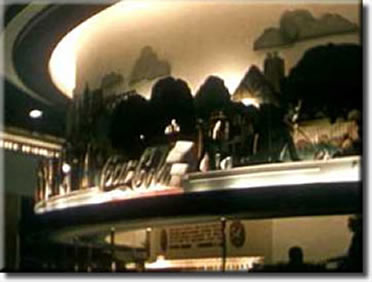
from the Medicus Film
History of Coco Cola
Produced by the Jam Handy Organization
Created in 1939, "Refreshment Through the Years" is a corporate history of the Coca-Cola Company. This film was the very first Technicolor industrial film ever produced. This account of the invention of Coke by John Pemberton through its growth in popularity to become the most popular soft drink in history.
Published on YouTube May 6, 2015 by Periscope Films
Periscope Film #72162. Approx Length: 20:30.
- Return to:
- Food Zone
- World's Fair Films